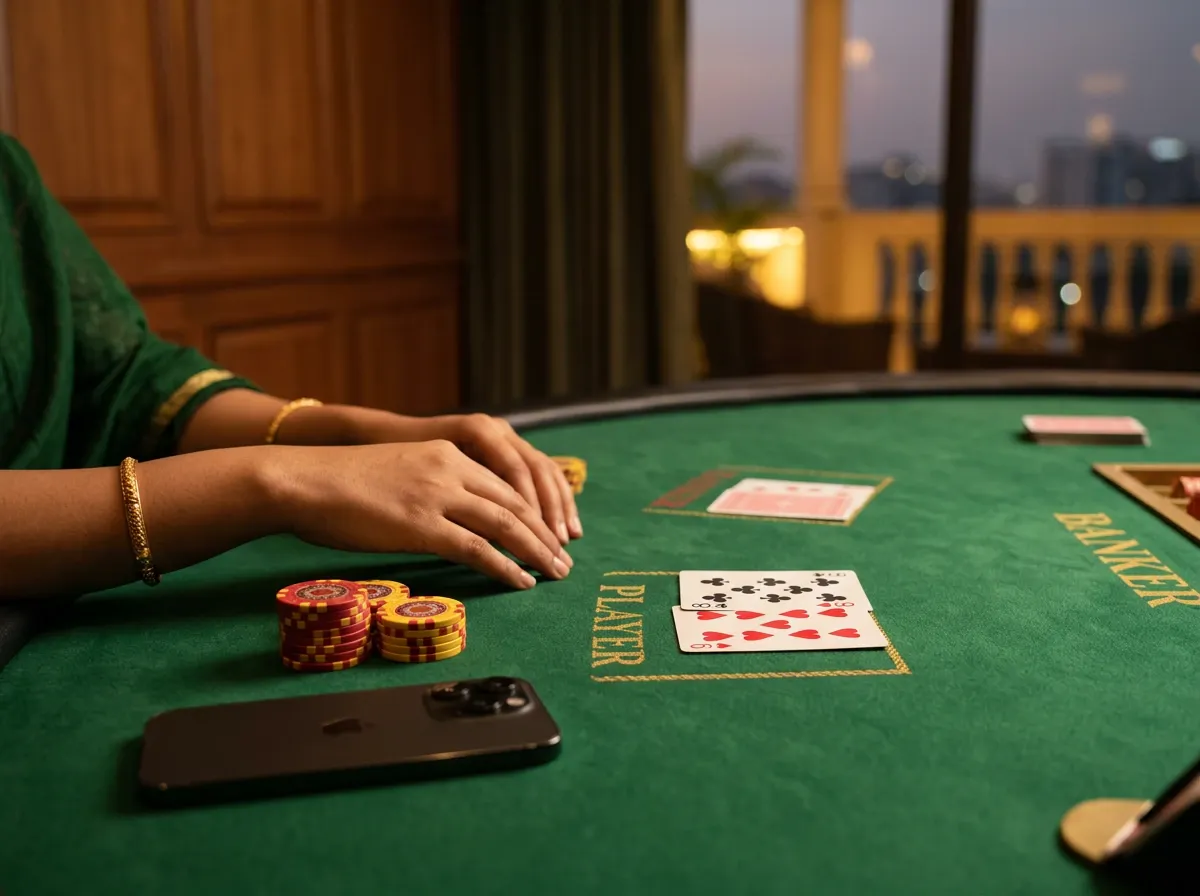
Understanding baccarat rules, odds of winning, and the built-in house edge protects you from irrational financial decisions. Baccarat math does not allow stable earnings — it only determines the speed of theoretical bankroll loss over time. Knowing this upfront is, frankly, the most valuable thing you can take from this section.
The core betting logic is built on three basic outcomes. Attempts to apply complex mathematical progressions do not change the built-in house edge. Players should analyze the payout structure before beginning a session — not after.
Main baccarat bets: banker, tie, and side options
The main bets divide by risk level:
- Banker — house edge 1.06%, wins 45.86% of non-tie rounds. Considered the mathematically optimal bet.
- Player — house edge 1.24%, wins 44.62% of non-tie rounds.
- Tie — house edge 14.36% at 8:1 payout (drops to 4.84% if the casino offers 9:1). Still far worse than the base bets either way.
Side bets (like Player Pair, Banker Pair, or Dragon Bonus) offer attractive payouts up to 20:1 or more; however, their house edge often exceeds 10%. They look exciting on the screen. They are expensive over time.
«After winning streaks, players significantly increased the proportion of high-risk bets — including Tie and pairs — compared to periods after losses.» — Taylor & Francis Online, Effects of sequential winning vs. losing on subsequent gambling behavior (2020). https://www.tandfonline.com/doi/full/10.1080/14459795.2020.1817969
This behavioral tendency makes awareness of real odds especially important: the temptation to escalate after wins is precisely when losses accelerate.
Payouts, RTP, house edge, and commission
The relationship between payout, RTP, and house edge is fixed. A Player bet returns 1:1. A Banker win also pays 1:1, but with a 5% commission withheld. This commission compensates for the Banker's positional advantage, preserving probability balance across thousands of hands.
Independent analyst Michael Shackleford confirms that card counting in baccarat provides less than 0.1% advantage even with perfect play from an 8-deck shoe, because frequent shuffles reset any count accumulation. In other words — don't bother.
«Card counting in baccarat yields under 0.1% edge even with ideal play using an 8-deck shoe due to frequent reshuffles.» — Wizard of Odds, Baccarat Basics (2024). https://wizardofodds.com/games/baccarat/appendix/1/
This debunks the popular misconception that card counting works in baccarat as it does in blackjack. And the belief that the ""tie bet is always worth it""? A gross mathematical error. At 8:1 payout, the tie bet generates a 14.36% loss over time. Even at 9:1, the house edge (4.84%) remains worse than either base bet.
Disclaimer: The information provided is general in nature and does not replace professional consultation. Gambling involves financial risk; participation is permitted only for adults in jurisdictions where it is legal. No betting strategy eliminates the casino's mathematical advantage.